Waste electric motors may look like ordinary metal scrap, but inside them is a valuable combination of copper, silicon steel, aluminum, iron, and other materials. For recyclers, the real challenge is not simply collecting old motors—it is recovering these materials efficiently while keeping the copper clean and minimizing processing losses.
That is where a Copper Recycling Machine for Motors can make a major difference.
Modern motor recycling equipment combines crushing, magnetic separation, refining, and air separation to turn complicated motor scrap into valuable recyclable materials. Instead of relying entirely on manual dismantling, recyclers can build a more consistent process that improves productivity and copper recovery.
So, how does a motor copper recycling machine work? What equipment is required? And how can you choose the right system for your business?
Let’s take a closer look.
1. Why Is a Copper Recycling Machine for Motors So Important?
Electric motors contain copper windings because copper offers excellent electrical conductivity and can be recovered as a valuable secondary raw material.
However, motor scrap is rarely a simple copper product. Windings are tightly combined with steel cores, insulation, varnish, plastic, and other components. If these materials are not separated correctly, the recovered copper can contain excessive impurities and lose commercial value.
For this reason, an efficient motor recycling machine needs to perform several jobs:
- Reduce the size of motor scrap
- Separate copper from ferrous materials
- Remove insulation and non-metallic impurities
- Improve copper purity
- Control dust generated during crushing
- Continuously transport material between processing stages
A properly designed recycling line can therefore transform difficult mixed scrap into several useful output streams.
2. How Does a Copper Recycling Machine for Motors Work?
A typical Copper Recycling Machine for Motors uses multiple processing stages rather than one machine performing every task.
The exact configuration depends on the motor type, input size, required capacity, and desired copper purity.
A typical process includes:
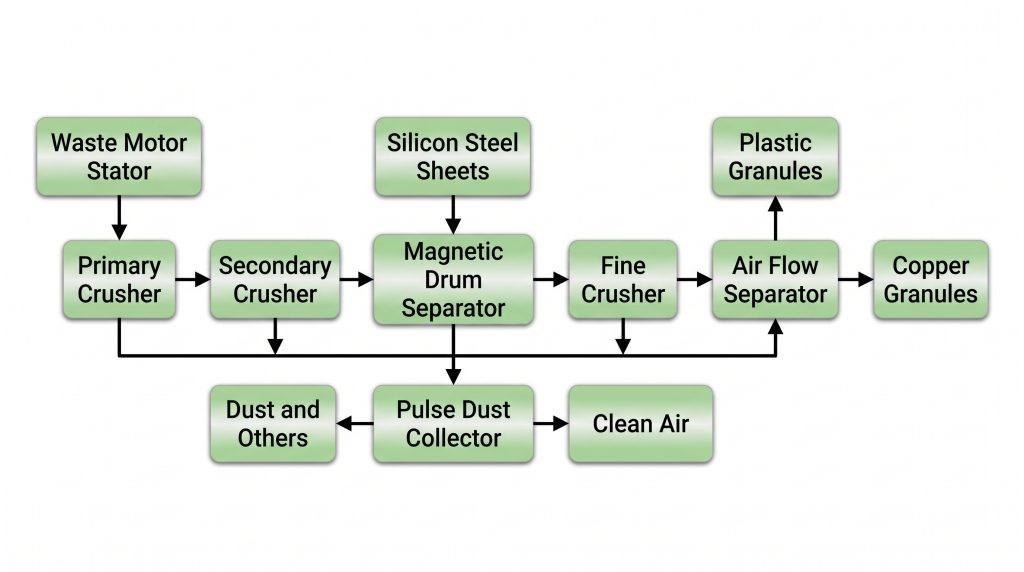
According to SUNY GROUP’s motor stator recycling solution, pre-sorted motor stators and windings are conveyed into primary and secondary crushing. Magnetic separation then removes silicon steel from the copper mixture, while further crushing and airflow separation help produce high-purity copper particles.
This multi-stage approach is important because separating materials gradually generally provides better control than attempting to recover copper in a single crushing step.
3. What Are the Main Machines in a Motor Copper Recycling Line?
A Copper Recycling Machine for Motors usually combines several types of equipment to handle different stages of the recycling process. Different motor recycling projects require different configurations. However, several types of equipment are commonly used.
Pre-Treatment Equipment
Large or complicated motors may first require dismantling or cutting.
A dismantling table can be used to remove housings, fasteners, and other components. For oversized copper coils, a cutting machine can reduce the material into smaller sections before crushing.
Primary Crusher
The primary crusher breaks down the motor structure and exposes the copper and steel components.
For certain difficult materials, a low-speed, high-torque dual-shaft shear crusher can be suitable. For copper coils and other materials that respond well to impact crushing, a hammer crusher may be used.
Magnetic Separator
After crushing, the mixture can contain copper, steel, and silicon steel.
A magnetic separator removes ferrous materials, allowing the copper-rich fraction to continue to the next processing stage.
This step is particularly important for motor stator recycling because stators contain substantial steel components.
Copper Granulator and Fine Separation
After iron and steel have been removed, the remaining copper mixture can be further crushed and refined.
A copper granulator helps separate copper granules from non-metallic materials such as insulation, plastic, and rubber. Depending on the material composition, additional separation technology may also be incorporated.
Dust Collection System
Crushing and separating scrap inevitably generates dust.
A modern recycling line can therefore incorporate a pulse dust collector and negative-pressure suction system to capture dust during processing. SUNY’s referenced solution specifically includes dust collection to reduce dust overflow and environmental impact.
4. What Materials Can Be Recovered?
A well-designed motor recycling line does more than recover copper.
The output may include:
Main product:
- Copper particles or granules
By-products:
- Silicon steel
- Ferrous metals
- Other non-metallic materials
The actual output composition depends heavily on the type of motors being processed and the condition of the incoming scrap.
For example, automobile motors, industrial motors, household appliance motors, and small electrical motors can have significantly different structures. Therefore, using the same recycling configuration for every application is not always the most efficient approach.
5. What Should You Consider Before Buying a Motor Copper Recycling Machine?
Choosing equipment based only on machine price can create problems later.
Before requesting a quotation, prepare at least these five pieces of information:
1. Motor Type
Tell the manufacturer whether you process industrial motors, automobile motors, household motors, generators, stators, or mixed motor scrap.
2. Feed Size
Large motors may require dismantling or cutting before entering the main processing line.
3. Processing Capacity
Estimate how much material you need to process per hour or per day.
Capacity affects the crusher size, conveyor configuration, separation equipment, motor power, and overall line design.
4. Desired Copper Purity
If your goal is to sell a cleaner copper product, the separation process must be designed accordingly.
5. Material Samples or Photos
This is one of the most useful steps.
Photos help manufacturers understand the motor structure, while actual material samples allow testing of the crushing and separation process. A professional supplier can then recommend a more suitable configuration instead of simply offering a standard machine.
6. Frequently Asked Questions About Copper Recycling Machines for Motors
Is a copper recycling machine suitable for all electric motors?
Not necessarily. Motor structures vary considerably. The ideal process depends on motor size, copper content, steel structure, insulation, and the required output.
Can the machine separate copper from steel?
Yes. Magnetic separation is commonly used to remove ferrous materials such as iron and silicon steel after crushing.
Can I process stators without completely dismantling them?
In many applications, yes. A properly configured crushing and separation system can process pre-sorted stators. However, the best solution depends on the stator dimensions and structure.
Does the recycling line produce pure copper?
The achievable purity depends on the feed material and equipment configuration. Secondary crushing, magnetic separation, granulation, and airflow separation can progressively improve the quality of the recovered copper.
How can dust be controlled?
A dust collection system, combined with negative-pressure suction and enclosed processing points, can help control dust generated during crushing and separation.
Should I buy individual machines or a complete recycling line?
For larger-scale operations, a complete line can simplify material handling and automate the connection between processing stages. For smaller operations, individual machines may provide greater flexibility.
7. How Can You Improve Copper Recovery?
The biggest gains often come from optimizing the entire process rather than simply increasing crusher power.
Copper recycling is also important from a resource-efficiency perspective.
The International Copper Association
provides additional information about copper’s role in a circular economy.
Start with proper sorting. Remove unsuitable materials before feeding the line.
Next, select the correct crushing method. Different motor components behave differently under shear, impact, or other crushing forces.
Then, pay close attention to separation. Magnetic separation should efficiently remove ferrous materials before copper granulation and fine separation.
Finally, monitor the finished product. If copper still contains excessive insulation, steel, or other contaminants, the separation stages may need adjustment.
In other words, better copper recovery starts with better process design.
Conclusion
A Copper Recycling Machine for Motors is more than a crusher. It is a complete material-recovery solution that can combine dismantling, crushing, magnetic separation, granulation, airflow separation, conveying, and dust collection.
For recyclers handling increasing quantities of motor scrap, a Copper Recycling Machine for Motors can turn a complicated waste stream into valuable copper and reusable metal by-products.
However, there is no universal machine configuration for every motor recycling project. The most effective solution depends on your motor type, feed size, processing capacity, material composition, and target copper quality.
Before purchasing equipment, provide your supplier with detailed material information, capacity requirements, and—if possible—photos or samples of the motor scrap. This allows the recycling line to be designed around your actual material rather than an assumed specification.
With the right process, motor scrap is no longer simply waste. It becomes a valuable source of recoverable copper and secondary raw materials.