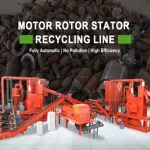
As electric vehicles become more common, the number of end-of-life electric motors is also expected to grow. Inside these motors are valuable materials, including copper, aluminum, steel, and permanent-magnet materials. Instead of sending old EV motors to waste streams, recyclers can recover these materials and return them to industrial supply chains.
However, recovering copper and aluminum from EV motors is not as simple as cutting open a motor and removing the visible metal. Modern electric vehicle motors contain tightly assembled components, insulated copper windings, aluminum housings, steel parts, and, in some designs, permanent magnets. Therefore, an efficient EV motor recycling process needs the right combination of dismantling, shredding, crushing, and separation technologies.
So, how can recyclers recover copper and aluminum from EV motors more efficiently? The answer lies in designing the process around material characteristics, minimizing unnecessary processing, and using effective separation equipment.
1. Why Are Copper and Aluminum Important in EV Motor Recycling?
Copper and aluminum are two of the most important recyclable metals found in electric motors.
Copper is commonly used in motor windings because of its excellent electrical conductivity. When recovered correctly, copper can become a valuable secondary raw material.
Aluminum, meanwhile, can be found in motor housings and other components. Its relatively low density and high recyclability make it attractive for material recovery.
For recyclers, this creates an important opportunity: instead of treating end-of-life EV motors simply as mixed scrap, the motors can be processed as a source of multiple valuable material streams.
The key challenge is achieving high-quality separation without excessive labor, energy consumption, or material loss.
2. Start With Effective EV Motor Dismantling
The first step toward efficient metal recovery is proper dismantling.
Before size reduction, recyclers should identify major components such as:
- Motor housing
- Copper windings
- Steel core and shaft
- Permanent magnets where applicable
- Aluminum components
- Other attached electrical or mechanical parts
Manual dismantling can work for small quantities, particularly when motors have different designs. However, labor requirements can increase rapidly when processing larger volumes.
For industrial operations, dedicated EV motor dismantling equipment can help standardize the process and prepare motors for downstream separation.
The goal is straightforward: remove or isolate large components before aggressive size reduction whenever doing so improves recovery efficiency.
3. Use Controlled Shredding and Crushing
After dismantling, some motor components may require shredding or crushing.
This stage reduces the material into smaller pieces, making subsequent separation easier. However, smaller is not always better.
Over-shredding can create fine mixed particles that are more difficult to separate. It can also increase energy consumption and potentially reduce the quality of individual material streams.
A better approach is controlled size reduction based on the characteristics of the incoming motor and the requirements of the separation system.
For example, copper windings need to be liberated from surrounding materials, while aluminum and steel components need to remain sufficiently distinguishable for downstream sorting.
Therefore, the objective should not simply be maximum size reduction. Instead, recyclers should aim for efficient liberation with minimum unnecessary processing.
4. Separate Copper From Steel and Other Materials
Once the motor has been reduced to a suitable size, separation becomes critical.
Magnetic separation can help remove ferrous materials such as steel from a mixed stream. This is particularly useful because electric motors can contain significant quantities of steel components.
Removing ferrous material early can improve the quality of the remaining non-ferrous fraction.
The remaining material can then undergo additional separation processes designed to concentrate copper, aluminum, and other non-ferrous materials.
This multi-stage approach is often more effective than attempting to recover every material in one step.
Why is copper recovery difficult?
Copper windings are often tightly integrated into the motor structure and may be covered by insulation. Consequently, simply crushing the motor may not produce clean copper.
An effective recycling system must therefore consider liberation, size control, and separation together.
5. Improve Aluminum Recovery With Material Separation
Aluminum recovery presents a different challenge.
Because aluminum is non-ferrous and relatively lightweight, it cannot be removed using conventional magnetic separation. Instead, recyclers may need additional sorting and separation technologies depending on the composition and particle size of the processed material.
The process should therefore be designed according to the desired final product.
If the objective is to produce cleaner aluminum scrap, the system may require multiple separation stages rather than relying on a single machine.
This is one reason why a complete electric motor recycling line can outperform isolated equipment when processing large quantities of mixed motor scrap.
6. Consider Permanent Magnets and Rare Earth Materials
Not every EV motor has the same internal composition.
Some permanent-magnet motors contain NdFeB magnets, which can include valuable rare earth elements such as neodymium. These materials create another potential recovery stream.
However, magnet recovery should not be treated exactly like copper or aluminum recovery.
Depending on the motor design, magnets may need to be removed before shredding or separated through specialized downstream processes.
Therefore, before purchasing an EV motor recycling machine, recyclers should identify the types of motors they expect to process.
Motor design directly influences equipment selection, process configuration, recovery targets, and operating costs.
7. Build the Recycling Process Around Your Actual Feedstock
One of the biggest mistakes recyclers can make is choosing equipment based only on a general motor recycling specification.
Different EV motors can vary significantly in:
- Motor design
- Housing material
- Copper content
- Magnet configuration
- Motor size
- Degree of contamination
- Component construction
- Required processing capacity
For this reason, a recycling line should be designed around the actual feedstock.
Before selecting equipment, consider three important questions:
What types of EV motors will you process?
Mixed motors may require greater flexibility than a consistent production stream.
How much material do you need to process?
A small recycling operation and an industrial plant have very different equipment requirements.
What final materials do you want to recover?
If copper and aluminum purity are the primary goals, the separation system should be configured accordingly.
Frequently Asked Questions About EV Motor Metal Recovery
Can copper be recovered from electric vehicle motors?
Yes. Copper windings can be recovered from EV motors through dismantling, mechanical processing, and appropriate separation methods. The exact process depends on motor construction and the required copper quality.
Can aluminum be recovered from EV motors?
Yes. Aluminum is commonly found in motor housings and other components. Because aluminum is non-ferrous, the recycling line needs suitable non-ferrous separation technology.
Is shredding enough to recover copper and aluminum?
Usually, no. Shredding reduces material size and helps liberate components, but additional sorting and separation are normally needed to produce cleaner material streams.
What equipment is needed for EV motor recycling?
A typical system may include dismantling equipment, shredders or crushers, magnetic separation, non-ferrous separation, conveyors, and other sorting equipment. The exact configuration depends on the feedstock and recovery targets.
How can recyclers improve recovery efficiency?
Start with accurate feedstock analysis, use controlled size reduction, remove ferrous material efficiently, and configure downstream separation according to the target materials. Testing representative motor samples before final equipment selection can also reduce project risk.
Conclusion
Recovering copper and aluminum from EV motors more efficiently requires more than simply processing motors through a shredder. The strongest results come from a well-designed recycling process that combines appropriate dismantling, controlled size reduction, and targeted material separation.
Copper, aluminum, steel, and potentially rare earth-containing magnets can all represent valuable recovery opportunities. However, the best equipment configuration depends on motor design, feedstock composition, processing capacity, and the quality requirements of the recovered materials.
As EV adoption continues to expand, efficient electric vehicle motor recycling will become increasingly important. For recyclers, investing in the right process today can turn complex end-of-life motors into valuable secondary resources.